Cedric Charlton’s first day strawberry picking
The Darling Buds of MayCedric Charlton’s first day strawberry picking transforms his formal visit to the Larkin farm into an encounter with the family’s working life. He sets out as an outsider, an Inland Revenue inspector interested in Pop’s unfiled return; he ends the day inside the harvest’s routines, temporarily exchanging the heat and strain of the field for the records table beneath the picking tent. The change is comic, but consequential: the official who came to examine the Larkins’ affairs becomes a participant in the seasonal economy he was trying to understand.
Causes and Seasonal Setting
The strawberry harvest belongs to a larger agricultural calendar that Pop knows by its succession of crops. Strawberries are followed by cherries, which continue through July; in favorable summers, apples can begin before August, alongside early plums and pears. Apples return in August and September, while September also brings hops and October potatoes. The sequence makes seasonal work—not a single crop—the framework of the family’s livelihood. At strawberries alone, Pop estimates, a large family could earn fifteen pounds a day.
The first strawberries are approaching as the truck passes fields between orchards. Pop points out that straw has been laid down and expects picking to begin within days. Later, Montgomery reports that the season at Benacre will start on Monday, earlier than ever before; Pop credits the weather with bringing the fruit on quickly. The early start places the harvest’s urgency in the same weather that will make the work difficult: it advances the crop, but also intensifies the heat in which the pickers must labor.
That seasonal confidence is shadowed by a warning about the industry’s future. Pop says disease has finished several named strawberry varieties—Sovereigns, Climaxes and Huxleys—and predicts that strawberries will soon be scarce everywhere. He expects the strawberry lark to be over within two years. The first-day harvest therefore takes place at a hinge between abundance and decline: the crop is ready unusually early, yet Pop’s experience tells him that the system supporting this familiar work may not last.
From Tax Visit to Invitation
Charlton’s connection to the harvest begins with the reason for his visit. The inspector tells Pop that official records show no income return for the previous year and produces the buff-colored form Pop says he never received. Pop answers the tax inquiry not by settling it, but by inviting Charlton in for food and drink. At the crowded family table, the visitor is surrounded by a profusion of dishes and offered more than he can plausibly want. The hospitality changes the tone of the encounter: rather than remaining a formal interview, the visit becomes an invitation into the household.
Pop continues that informal welcome through lodging and meals. He asks Charlton to stay overnight, and Ma agrees; the proposed bed is on the billiard table. When Charlton later hesitates over Sunday dinner, Ma and Pop again press him to eat with them rather than fend for himself. These offers make belonging something practical and repeated—food, a place to sleep, and a place at the table—before the inspector has settled into the household’s rhythm.
The decisive step toward the fields comes when Pop and Ma urge Charlton to use sick leave. Pop argues that Charlton has paid into the National Health Service and should take advantage of it, presenting a week away from work as an opportunity for enjoyment rather than an ethical breach. The evening’s pressure is also personal: Mariette kisses Charlton and asks him to stay longer, while he struggles with thoughts of duty and loyalty. By morning, those competing appeals have brought him to the point of joining the Larkins’ trip to the harvest.
The First Morning in the Field
Charlton rises to a substantial breakfast—two fried eggs, liver and bacon, fried bread, and large cups of sweet black tea—yet feels well and cannot identify any illness to report to his office. Pop, already breakfasting beneath a sea of tomato ketchup, celebrates the first young strawberry morning and says the day will be perfect. He jokes that Charlton will have lumbago by nightfall, after a day in the field. His prediction turns the work ahead into a test that the inexperienced office worker is not prepared to meet.
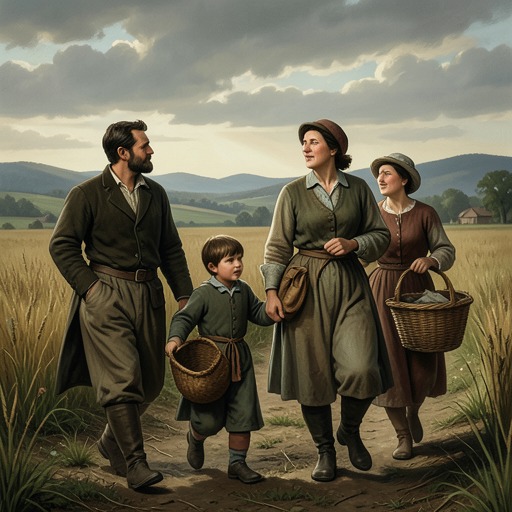
At eight, Charlton rides in the back of the gentian-blue truck with Mariette, Montgomery, Victoria, Primrose and the twins, while Pop and Ma take the cab. Ma jokes that the whole party could have traveled in the Rolls-Royce merely to surprise people. Pop calls back to check on the passengers and tells the children to hang on by their toenails; before the truck has gone far, the family is singing together. Charlton has never ridden in a truck’s open back or sung on a public highway. The journey exposes, in a single scene, how far he has been drawn from the office-bound habits that defined him at the beginning of the visit.
The field makes that distance physical. Charlton tries to concentrate on the strawberries but anticipates a terrible day beneath the clear, hot sun. The previous day had been, according to the newspapers, the hottest May 30 in forty years, and he expects this one to be hotter. He does not want to eat the berries; he longs instead for a cool, quiet place beneath the chestnut saplings. Mariette recognizes his discomfort and directs him toward the tent, where the baskets are weighed and checked.
The Tent Becomes an Office
The tent provides Charlton with a way to remain useful without continuing to pick. Pop, who is having his first baskets checked, introduces him to the foreman, Mr Jennings, as an office worker connected with the tax lark. Jennings promptly offers him a seat and a job: weighing and booking the baskets. He needs someone to handle the records so that the pickers can be paid at the end of the day, and would rather leave that task to Charlton than spend his time checking the women’s baskets himself.
Pop celebrates the reassignment as an immediate promotion, claps Charlton on the shoulder and shakes his hand. Once seated at the table in the tent’s green shade, Charlton feels much more himself; with a chair beneath him, the work resembles his office job. Jennings explains the straightforward procedure of weighing and recording each basket and its picker’s name. A task that preserves Charlton’s clerical skills thus rescues him from the labor he has discovered himself unable to bear, while still placing him inside the harvest’s operation.
The arrangement also gives the day a striking measure. Under the May sun, Charlton returns to the tent and calculates how much fruit has passed through it. He has checked in more than a ton of strawberries. The scale astonishes him, and he reasons that it must represent a substantial return for the pickers. His trained mind then turns toward the tax position and toward Pop, whom he is sure will know the answer. The tax inquiry that first brought him to the farm has not disappeared; instead, the harvest has given it a concrete human and economic dimension.
Consequences and Significance
Charlton’s first day alters his position without making him a field hand in the ordinary sense. The heat and discomfort establish his limits; the weighing table allows him to contribute through office work. His practical usefulness is recognized by Jennings, and Pop’s warm approval makes the reassignment a small act of incorporation into the Larkins’ working company. The inspector is no longer merely an official at the family’s door: he is keeping the records by which the pickers’ baskets will be paid.
The day also sharpens the contrast between the household’s generous abundance and the precariousness of its seasonal economy. The family’s food and hospitality seem inexhaustible, while the strawberry harvest depends on weather, the timing of ripening, the availability of labor and the health of the crop. Charlton sees more than a ton pass through the tent in one day; Pop, looking further ahead, sees disease and the possible end of strawberry picking. The same harvest can therefore appear as immediate income to the pickers, as a working opportunity to Charlton, and as a livelihood under threat to Pop.
As a narrative turning point, the first day converts a bureaucratic visit into a shared routine. Charlton’s records connect his professional habits to the family’s informal economy, while the early start, blazing heat and Pop’s forecast of the industry’s decline keep the work grounded in its seasonal and material conditions. He arrives to pursue an unfiled return; by the end of the day he has counted the fruit that makes the strawberry lark visible from the inside.